

When you search for massage therapy in Austin, you'll likely see phrases like "certified massage therapist" everywhere. But what does that actually mean for your safety and the quality of your care? Many people assume that "certified" signals legal authorization to practice, when in reality, the picture is more nuanced. Understanding the difference between certification and licensing can directly shape your health outcomes, especially if you're managing chronic pain, recovering from an injury, or simply trying to find consistent, trustworthy support for your body and nervous system.
Table of Contents
- What does 'certified massage' mean?
- Massage licensing vs. certification: The Texas landscape
- Why credentials matter for chronic pain, stress, and recovery
- Practical questions to ask your Austin massage therapist
- Our take: Credentials are a starting point, not the whole story
- Experience certified, licensed massage therapy tailored for you
- Frequently asked questions
Key Takeaways
| Point | Details |
|---|---|
| Certification vs. licensure | Certification shows specialized training, but only Texas licensure (LMT) is legally required to practice massage. |
| Check every credential | Always confirm your Austin therapist is licensed and ask about any specialty certifications for your needs. |
| Your needs come first | Quality care involves both formal credentials and how well a therapist understands your holistic goals. |
| Ask the right questions | Before booking, use clear questions to verify the therapist’s education, experience, and legal standing. |
What does 'certified massage' mean?
To understand what to look for, start with the basic definition of "certified massage." The term gets used in a lot of different ways, and that's where much of the confusion begins.
At its simplest, certification means a practitioner has completed a specific training program or passed an exam offered by a professional organization. That sounds reassuring, and it often is. But as Understanding Massage Titles makes clear, "certified massage" usually refers to a practitioner having completed a certification program or passing a certification exam through a specific organization; it is not automatically the same thing as being legally licensed by the state.
Think about that for a moment. A therapist could have a certificate from a weekend workshop and call themselves "certified." That same word could also describe someone who completed an advanced 200-hour specialty course in myofascial release. The word itself doesn't tell you enough on its own.
The key distinction: Certification confirms training or competency through a specific program or organization. Licensing is a legal credential granted by the state. They are not interchangeable, and one does not automatically include the other.
This distinction matters most when you're trusting someone with your body, especially for therapeutic purposes like pain relief, injury recovery, or stress management. A certification is often voluntary. It's a professional credential that shows a therapist went beyond the minimum to prove competence or develop a specialty. But it doesn't replace the legal requirement to be licensed.
Here are the key attributes that define certification in the massage therapy world:
- Education-based: Most certifications require completing a structured program, often ranging from a few hours to several hundred hours of training.
- Voluntary: Unless required by an employer or specialty field, certifications are generally optional, not mandated by law.
- Organization-specific: Different organizations issue different certifications. The NCBTMB (National Certification Board for Therapeutic Massage and Bodywork) is one of the most recognized, but many others exist.
- Not always legally required: Holding a certification alone does not legally authorize someone to practice massage therapy in most states, including Texas.
- Specialty-focused: Many certifications signal advanced skills in specific areas, such as sports massage, prenatal massage, or lymphatic drainage.
When you're exploring professional massage options in Austin, understanding these distinctions helps you ask the right questions and find a therapist who genuinely meets the standard of care your body needs.
Massage licensing vs. certification: The Texas landscape
With the definition in mind, let's clarify the real legal and professional requirements in Austin, Texas. Because when it comes to actually practicing massage therapy here, there is a clear baseline that every legitimate therapist must meet.
In Texas, the credential you need to confirm is the LMT, which stands for licensed massage therapist. As outlined by Texas Massage Therapy Licensing requirements, the licensed massage therapist designation is the state-issued credential. License requirements include completing an approved education program, passing an exam, and applying through the Texas Department of Licensing & Regulation (TDLR). This is not optional. This is the legal floor for practicing massage therapy in Austin.
Here's a side-by-side comparison to help clarify the difference:
| Credential | Issued by | Required to practice? | What it involves |
|---|---|---|---|
| Texas LMT (Licensed Massage Therapist) | Texas TDLR (state agency) | Yes, legally required | 500+ hours of education, background check, state exam, licensure application |
| NCBTMB Certification | National Certification Board for Therapeutic Massage & Bodywork | No, voluntary | Written exam, demonstration of competency, continuing education |
| MBLEx (Massage & Bodywork Licensing Exam) | Federation of State Massage Therapy Boards | Used to qualify for state licensing | Standardized exam, often a prerequisite to state licensing |
| Specialty Certifications (e.g., sports, prenatal) | Various schools or professional organizations | No, voluntary | Program completion, often includes supervised hours |
What you'll notice immediately is that a Texas LMT and a specialty certification serve very different purposes. The LMT is your assurance that a therapist has met the state's minimum educational and safety requirements. Specialty certifications layer on top of that, showing a therapist has invested extra time and skill in a particular area.
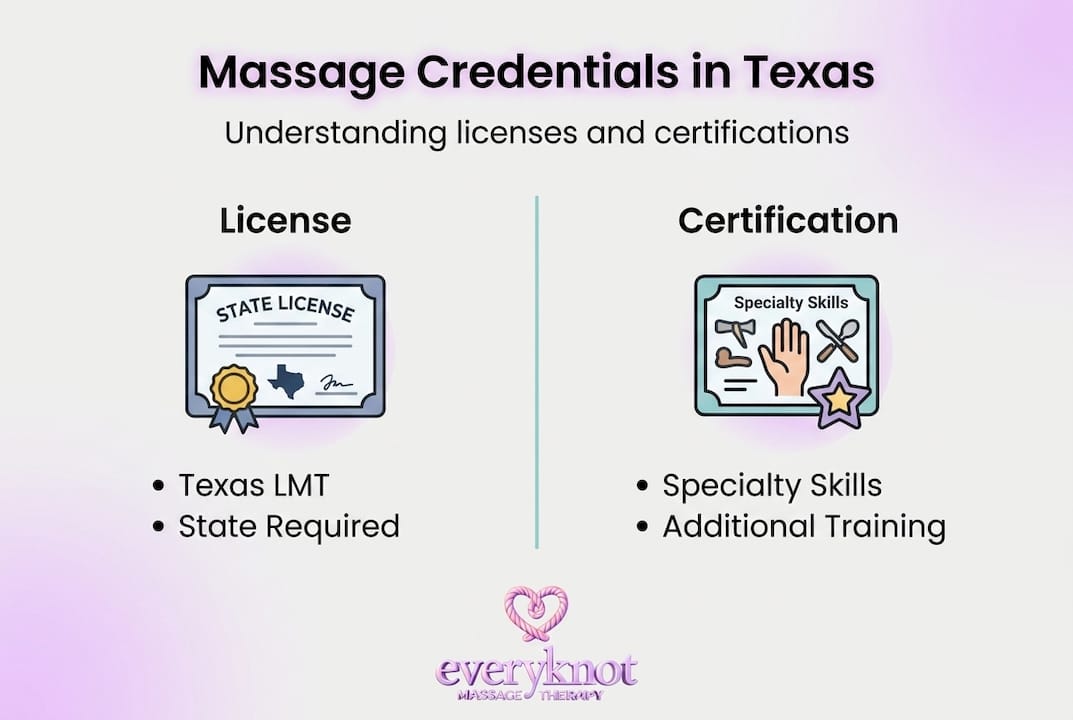
For clients dealing with specific concerns like chronic pain, sciatica, or injury recovery, that layered picture matters. An LMT with an advanced certification in neuromuscular therapy, for example, brings both legal authorization and specialized technical knowledge to your session.
Pro Tip: Before booking any massage in Austin, ask the therapist directly: "Are you licensed with the Texas TDLR?" You can also verify therapists licensed in Texas through the TDLR's public lookup tool online. This single step protects you and sets the right foundation for your care.
Why credentials matter for chronic pain, stress, and recovery
Now that you know the difference, here's why it directly impacts your health outcomes. Credentials aren't just paperwork. They're a reflection of the education, accountability, and commitment a therapist brings to your care.
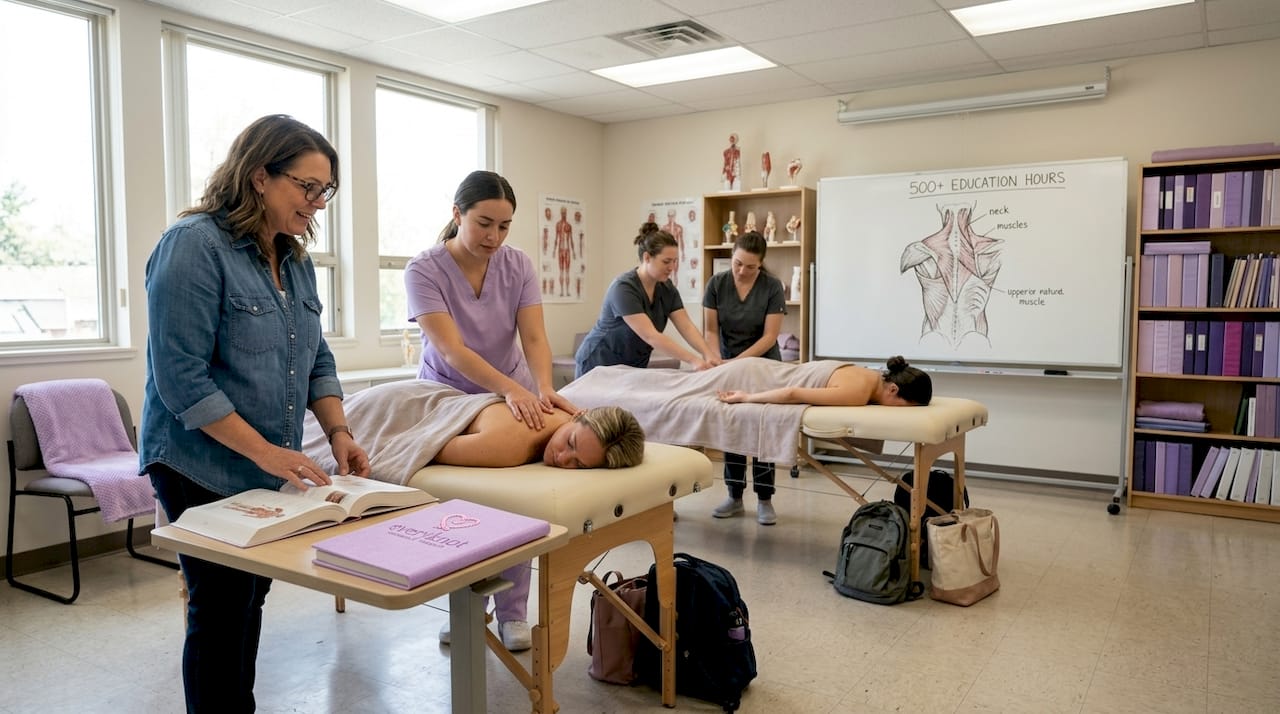
A licensed massage therapist in Texas has completed, at minimum, 500 hours of approved education. That training covers anatomy, physiology, pathology, and hands-on technique. It means a therapist understands how muscles, nerves, and connective tissue interact, which is critical when you're coming in with something more complex than everyday tension. When you're managing a chronic condition or recovering from an injury, that foundational knowledge is what helps a therapist recognize when to adjust pressure, avoid certain techniques, or refer you to another provider.
As Texas Massage Therapy Licensing guidance notes, if you want massage for chronic pain, stress management, or recovery, you should confirm whether the therapist is at least Texas licensed and whether they hold any additional specialty certifications. That two-part check gives you confidence both in safety and in specialized skill.
Specialty certifications are where things get interesting for therapeutic clients. A therapist certified in deep tissue work understands fascial layers and how chronic holding patterns develop over time. A prenatal-certified therapist knows how positioning and pressure change during pregnancy. A therapist trained in trauma-informed practice understands how to work with clients whose nervous systems need gentle, intentional support before they can fully release tension.
Here's a simple process to check credentials before you book:
- Look up their Texas LMT license through the TDLR's online verification tool. This confirms they are legally authorized to practice.
- Ask what certifications they hold beyond their LMT, and what organizations granted those credentials. Reputable certifying bodies include the NCBTMB and established massage schools.
- Ask about their specialty training and whether it aligns with your needs. A therapist who specializes in Austin therapy for pain relief should be able to clearly describe how their training supports clients with chronic pain or injury recovery.
- Ask how recent their continuing education is. Texas LMTs are required to complete continuing education to renew their license, which keeps skills and knowledge current.
Pro Tip: Ask your therapist specifically how they maintain their certifications. Ongoing education matters enormously. A therapist who attends advanced trainings annually is a very different practitioner from someone who completed a course five years ago and stopped there.
Practical questions to ask your Austin massage therapist
With credentials explained, being proactive matters. Here's what to ask before you book, and what each answer tells you.
Many clients feel uncertain about whether they're overstepping by asking a therapist about their credentials. You are not. These are professional questions, and any skilled, ethical therapist will welcome them. Vague marketing language is common in the wellness industry, and as License vs Certification for Massage Therapists points out, "certified" may be used loosely in marketing to mean "trained" or "passed a course," so the safest approach is to ask what specific credential it refers to.
Here are the four core questions to ask before you commit to a session:
- Are you licensed in Texas as an LMT? This is the single most important question. A "yes" tells you they've met the state's legal and educational standards.
- What certifications do you hold beyond your LMT? This helps you understand their areas of specialty and depth of training.
- How do you stay certified or maintain your continuing education? This reveals their commitment to growth and staying current in a field that continues to evolve.
- What is your specialty or primary training focus? This tells you whether their background genuinely aligns with your specific needs, whether that's chronic pain, prenatal care, injury recovery, or stress relief.
Here's a quick reference table for reading responses and what they signal:
| Therapist's answer | What it means | Your next step |
|---|---|---|
| "Yes, I'm licensed by the Texas TDLR" | Legal baseline confirmed | Ask about specialty training |
| "I'm certified through [named organization]" | Voluntary credential, confirm LMT status separately | Ask if they're also Texas licensed |
| "I've completed several courses" | Vague; unclear credentials | Ask for specifics on licensure |
| "I trained in deep tissue and hold NCBTMB certification" | Strong indicators; still confirm Texas LMT | Good sign; proceed with care discussion |
| Cannot confirm state licensure | Significant concern | Do not book; seek a licensed provider |
Look for specificity. A well-qualified therapist will be clear and confident about their credentials. They should be able to name the certifying organization, the year they completed training, and what it focused on. If answers feel evasive or overly general, trust that instinct and keep looking. Your well-being is worth that extra step of research.
When it comes to massage therapist standards, the details matter. Asking these questions before your first session isn't just smart, it sets the tone for a therapeutic relationship built on honesty and mutual respect.
Our take: Credentials are a starting point, not the whole story
Here's something we've observed working with clients managing real, ongoing pain: many people spend a lot of energy searching for the word "certified" and then stop there. That word provides a feeling of security. But it can actually lead you to overlook what matters most.
Credentials, including the Texas LMT and any specialty certifications, represent the foundation. They tell you a therapist has met minimum standards and invested in their craft. What they don't tell you is whether that therapist listens carefully, adapts to your body session by session, or creates the kind of supported environment where your nervous system actually feels safe enough to release.
The most effective therapeutic relationships we see combine all of it. Yes, licensure matters. Yes, specialty training matters. But so does a therapist who communicates clearly, checks in during your session, and remembers what was happening in your body last time you came in. Reviews, referrals, and your own gut sense of ease in the room are real data too.
We believe in credential transparency because trust starts there. But we also encourage you to look beyond the checklist. The EveryKnot Massage approach brings both full licensure and genuine attentiveness to every session, because healing requires both technical skill and human presence.
Experience certified, licensed massage therapy tailored for you
If you've been carrying chronic tension, managing recurring pain, or navigating a recovery that keeps stalling, working with a fully licensed and credentialed therapist changes everything.
At EveryKnot Massage in Austin, Caitlin is a licensed massage therapist in Texas who holds additional certifications across multiple therapeutic modalities, including deep tissue, prenatal care, and injury recovery support. Every session is customized, intentional, and built around what your body actually needs that day. You deserve care from someone who meets every standard and then goes further, combining technical knowledge with genuine presence. Reach out to learn more or book your session today.
Frequently asked questions
Is a certified massage therapist the same as a licensed massage therapist in Texas?
No. In Texas, only a licensed massage therapist (LMT) is legally authorized to practice; certification alone does not grant that legal standing. Always confirm your therapist holds a Texas LMT credential before booking.
What is required to become a licensed massage therapist in Austin?
To be licensed in Austin, therapists must complete 500+ hours of education, pass an approved exam, and receive licensure through the Texas TDLR. A background check is also required as part of the application process.
How can I verify a massage therapist's credentials in Texas?
You can look up a therapist's license through the Texas Department of Licensing and Regulation's public database, or simply ask the therapist directly to provide their license number and certifying organizations.
Do specialty certifications matter for pain or recovery massage?
Yes. Specialty certifications show a therapist has pursued advanced skills beyond their base licensure, which can be particularly valuable for clients with chronic conditions, injury histories, or complex therapeutic needs.