

Your body sends signals long before things get serious. Most people brush off those signals as normal. Sore neck after a long week? Just stress. Can't sleep? Must be your schedule. Shoulders that feel like concrete? You'll stretch it out eventually. But these are real signs you need a massage, and waiting tends to make each one worse. This article breaks down the most telling physical and mental indicators that your body is asking for therapeutic support, so you can make a confident, informed decision about when to get a massage.
Table of Contents
- Key takeaways
- 1. Signs you need a massage: what to look for first
- 2. Persistent muscle tightness in your neck, shoulders, or back
- 3. Muscle knots and trigger points that won't release
- 4. Reduced range of motion interfering with daily tasks
- 5. Chronic pain lasting more than a few weeks
- 6. Frequent tension headaches
- 7. High stress, anxiety, and emotional tension showing up physically
- 8. Poor sleep quality and constant fatigue
- 9. Slow recovery after exercise or physical activity
- 10. Swelling, heaviness in limbs, or poor circulation signs
- My perspective on listening to your body
- Ready to address what your body has been telling you?
- FAQ
Key takeaways
| Point | Details |
|---|---|
| Pain that persists beyond days | Muscle pain lasting more than a few days is a clear signal to seek massage therapy, not just rest. |
| Stress shows up physically | Tension headaches, tight shoulders, and poor sleep are all physical symptoms of stress that massage can address. |
| Recovery delays matter | If your muscles stay sore for days after exercise, massage may speed up tissue repair and reduce inflammation. |
| Safety comes first | Chronic pain lasting over three months deserves medical evaluation before or alongside massage therapy. |
| Routine beats single sessions | Consistent, scheduled massage produces better outcomes than a single session when managing ongoing symptoms. |
1. Signs you need a massage: what to look for first
Before we get into specific symptoms, it helps to understand the framework for evaluating whether massage therapy is right for what you are experiencing. Not every ache points to the same need. What matters is the pattern, the duration, and how your symptoms affect your daily life.
Here is what to assess:
- Duration: Has the discomfort lasted more than a few days without improving on its own?
- Location and spread: Is the tension concentrated in one area, or does it radiate into other parts of your body?
- Mobility impact: Is tightness or pain limiting your ability to turn your head, bend forward, or move without wincing?
- Sleep disruption: Are you waking up more tired than when you went to bed?
- Stress load: Has your mental or emotional stress been consistently high for weeks?
One factor that people often overlook is the connection between daily habits and physical symptoms. Massage therapists assess posture, workstation setup, and activity load to determine whether recurring tightness is a pattern worth treating or an isolated response to exertion. That context matters before you book.
Pro Tip: If you are unsure whether your symptoms are massage-appropriate, write down when they started, what makes them better or worse, and how they affect your day. This gives any therapist a much clearer picture of where to focus.
2. Persistent muscle tightness in your neck, shoulders, or back
This is the most common sign people recognize but wait too long to act on. Muscle tightness that hangs around for more than a few days, especially in the neck, upper back, or lower back, is your body asking for more than a hot shower. These areas hold most of the physical burden of modern life: screen time, desk work, driving, and stress.

The tension in these muscles is not always caused by a single event. It builds quietly. Over time, the fibers shorten and the surrounding tissue thickens, making the area harder to release without hands-on work. Massage therapy for low-back and chronic neck pain has solid research behind it, especially when addressed consistently.
Pro Tip: If you notice your shoulders creeping up toward your ears during the day, that involuntary guarding is a sign of chronic tension. Your body has adapted to a state of bracing. Massage helps reset that pattern.
3. Muscle knots and trigger points that won't release
You know the spots. That dense, tender nodule in your shoulder blade that hurts when you press it, and sometimes sends a dull ache down your arm. These are trigger points, and they do not go away with stretching alone.
Trigger points form when muscle fibers get locked in a contracted state and cannot release. They reduce local circulation, cause referred pain in other areas, and signal ongoing stress in that tissue. A trained therapist uses targeted pressure and technique to break the contraction cycle and restore normal blood flow.
Left untreated, trigger points contribute to postural imbalances, headaches, and limited movement. If you are pressing on a spot and the ache radiates somewhere else, that referral pattern is your body telling you something specific.
4. Reduced range of motion interfering with daily tasks
Can you turn your head fully to check your blind spot while driving? Can you reach overhead without discomfort? Range of motion is an easy daily test that reveals a lot about what is happening in your muscles and connective tissue.
When movement becomes restricted, it means the surrounding tissue is tight, inflamed, or guarded. A randomized trial found that Swedish massage three times per week for eight weeks significantly improved range of motion, reduced pain scores, and improved knee function in older adults with osteoarthritis, with no serious adverse events. This is not a minor quality-of-life issue. Restricted motion affects your posture, your gait, and over time, your ability to stay active.
5. Chronic pain lasting more than a few weeks
Chronic pain is different from acute soreness. It persists beyond normal healing timelines, often for months, and tends to affect mood, sleep, and energy alongside physical function. If you have been managing discomfort in the same area for more than a few weeks, massage therapy is worth considering as part of a broader plan.
Research shows that Thai massage for chronic low back pain produces real improvements in pain and functional outcomes when delivered consistently. For longer-term pain, chronic discomfort beyond a few months is typically addressed as symptom burden reduction within a comprehensive care plan, not a standalone fix. Massage works best when it is part of that wider approach.
If your pain has been present for more than three months, see a healthcare provider before or alongside starting massage. That is not a reason to avoid massage; it is a reason to make sure your care is coordinated.
6. Frequent tension headaches
Tension headaches are one of the less obvious signs you need massage therapy. They originate in the muscles of the neck, base of the skull, and upper shoulders, not the head itself. When those areas are chronically tight, referred pain travels upward and creates the characteristic band of pressure across the forehead or behind the eyes.
Research on massage for headaches is preliminary but encouraging. What is more telling is the pattern: if your headaches consistently appear after stressful days, long hours at a desk, or poor sleep, the source is almost certainly muscular. Treating the neck and shoulder tension directly often reduces both the frequency and intensity of headaches over time.
7. High stress, anxiety, and emotional tension showing up physically
This is where physical and mental signs converge. When stress is high and sustained, the body produces cortisol and keeps muscles in a low-grade state of tension. You may not feel acutely stressed, but your body holds the evidence: raised shoulders, a clenched jaw, a tight chest, or shallow breathing.
These are indicators you need relaxation support, not just better time management. Massage therapy activates the parasympathetic nervous system, shifting your body out of fight-or-flight and into a state where tissue can actually release. This is what makes massage different from simply resting. You are not just stopping the stressor; you are actively helping your nervous system feel safe enough to let go.
8. Poor sleep quality and constant fatigue
If you are sleeping seven to eight hours but still waking up exhausted, muscle tension is often the overlooked cause. Tight muscles interfere with deep sleep cycles because your body cannot fully relax. You wake still carrying the tension you went to bed with.
Fatigue linked to fibromyalgia and similar chronic conditions has shown temporary but meaningful improvement with consistent massage. Even without a formal diagnosis, the connection between unresolved tension and poor sleep quality is well-recognized. Addressing the physical component often produces a noticeable shift in sleep depth within a few sessions.
Constant fatigue is one of the most undervalued signs of muscle tension. When your body is working hard just to maintain posture and manage ongoing tightness, you burn energy around the clock.
9. Slow recovery after exercise or physical activity
If your muscles are still sore three or four days after a workout or active day, that is not normal conditioning. That is delayed recovery, and it suggests your body is struggling to clear metabolic waste and repair tissue at a healthy rate.
Massage increases circulation to fatigued muscles, moves fluid that has pooled in sore tissue, and helps the nervous system downregulate after exertion. For people who train regularly or have physically demanding jobs, massage for recovery is less of a luxury and more of a maintenance practice. Think of it the way you think about sleep or hydration: skip it often enough, and performance eventually suffers.
10. Swelling, heaviness in limbs, or poor circulation signs
Heavy legs, puffiness around the ankles after a long day, or the sensation that your arms feel dense and sluggish. These are often circulation-related signs that massage can directly support. Specific techniques, including lymphatic drainage and light effleurage, help move stagnant fluid and encourage better return circulation.
This matters especially for people who sit or stand for extended periods without much movement. Swelling that appears suddenly or on one side only, or that comes with significant pain, warrants a medical check before booking. But mild, recurring heaviness after sedentary days is a reliable indicator that your circulatory system would benefit from some manual support.
Here is a quick reference for urgency based on the type of sign:
| Sign | Urgency | Recommended action |
|---|---|---|
| Persistent muscle tightness (days) | Moderate | Book a massage soon |
| Trigger points with referred pain | Moderate to high | Schedule therapeutic massage |
| Limited range of motion | High | Massage plus mobility work |
| Chronic pain over 3 months | High | Medical eval first, then massage |
| Tension headaches (recurring) | Moderate | Massage focused on neck and shoulders |
| Post-exercise soreness (3+ days) | Low to moderate | Add regular massage to routine |
| Swelling or heaviness (sudden, one-sided) | High | See a doctor before massage |
| Stress-related muscle tension | Moderate | Book massage, address stressors |
My perspective on listening to your body
I have worked with enough people at this point to notice a pattern that almost never changes. The clients who come to me describing "just a little tightness" in their neck have usually been living with it for six months. They managed it. They pushed through. And by the time they arrive, what started as a minor annoyance has become a chronic holding pattern that takes real time and consistent work to unwind.
The idea that you should tough it out until something snaps is one of the most counterproductive beliefs I see. Your body's early signals are not weakness. They are useful information. A tight shoulder at week one is far easier to address than a trigger point complex at month six.
What I have also learned is that people often do not realize how much tension they are carrying until they feel the difference. Many of my clients leave their first session surprised by how much they had normalized. That is not a failure on their part. That is just how the body adapts. It is quiet and efficient at hiding discomfort until it cannot anymore.
My honest advice: do not wait for the crisis appointment. If you recognize three or more of the signs in this article, that is enough. Consistent, intentional massage is preventive care, not just relief. The earlier you start, the less there is to undo.
— Caitlin
Ready to address what your body has been telling you?
If you recognized yourself in any of the signs above, you do not need to keep waiting for things to improve on their own. At Everyknotmassage, every session is built around your specific symptoms, patterns, and goals. Whether you are dealing with chronic tension, recovering from an injury, managing stress, or looking for prenatal massage support, Caitlin brings both technical depth and genuine presence to every session in her Austin, TX studio.
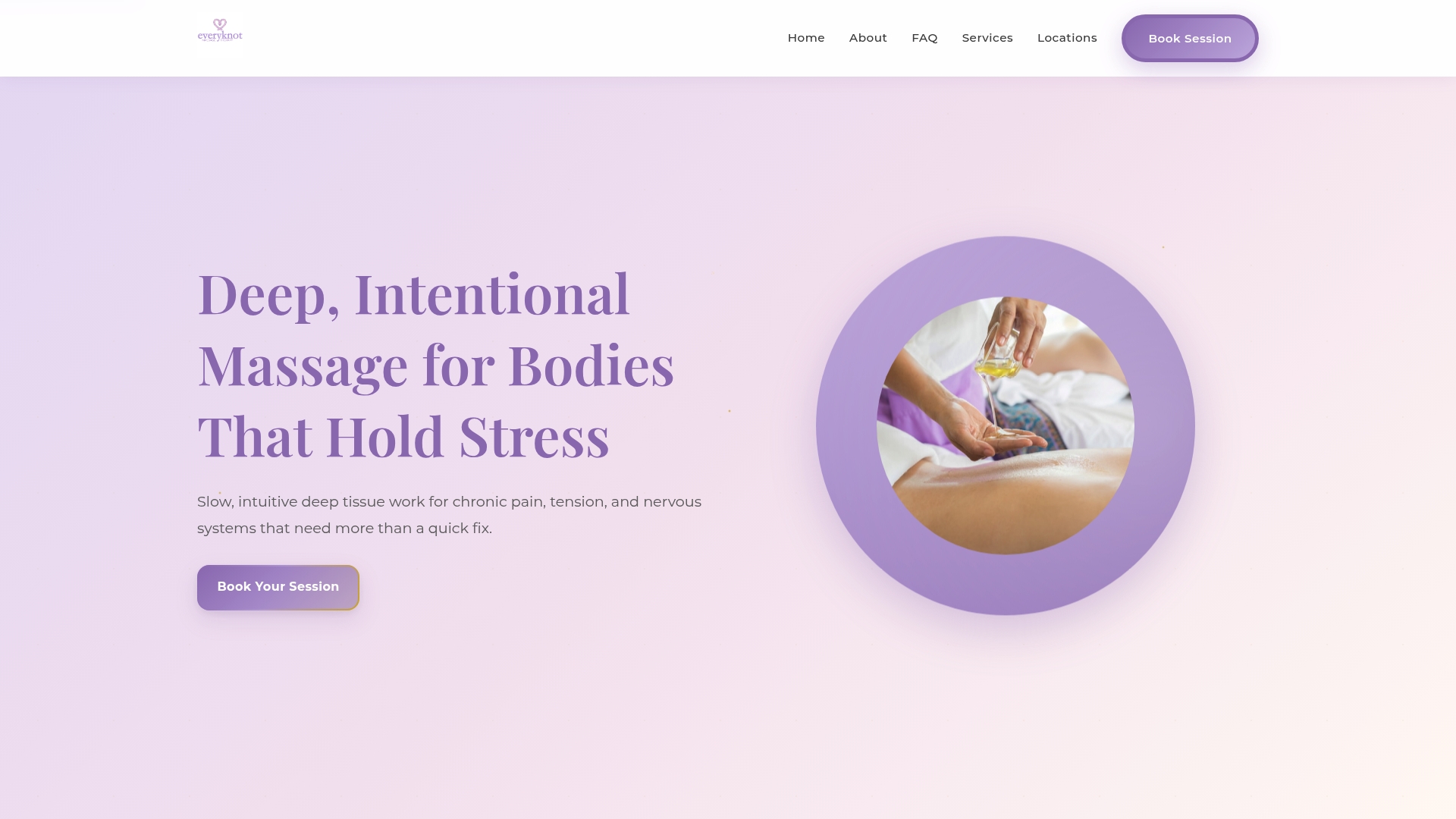
Sessions are customized from the first appointment. There is no one-size-fits-all here. If you are in Austin and ready to feel what it is like to actually let your body release, booking is straightforward and welcoming. Your body has been asking. This is a good time to listen.
FAQ
What are the most common signs you need a massage?
The most common signs include persistent muscle tightness in the neck or back, recurring tension headaches, poor sleep, and post-exercise soreness that lasts more than two to three days. Stress-related symptoms like jaw clenching and shallow breathing are also reliable indicators.
How do I know if I need a massage or a doctor?
If your pain has lasted more than three months, comes with numbness or tingling, appears suddenly and severely, or is accompanied by fever, see a healthcare provider before booking massage. For general muscle tension and stress, massage is a safe and appropriate starting point.
How often should you get a massage for ongoing tension?
Regular, structured sessions produce better results than occasional visits. For chronic tension or pain, every two to four weeks is a common starting point, adjusted based on how your body responds.
What are the signs you need a prenatal massage?
Signs you need prenatal massage include lower back pain, hip tightness, swelling in the legs or feet, sleep difficulty, and stress during pregnancy. A certified prenatal massage therapist can address these safely with positioning and pressure adjustments designed specifically for pregnancy.
Can massage really help with stress and fatigue?
Yes. Massage activates the parasympathetic nervous system, reducing cortisol and encouraging physical release of muscle tension caused by stress. Research on fibromyalgia fatigue and related conditions supports meaningful, if temporary, relief from both fatigue and stress-driven discomfort.