

Finding a massage therapist in Austin who genuinely understands chronic pain, injury recovery, or stress-related tension is harder than it sounds. Austin has hundreds of practitioners, ranging from spa generalists to highly specialized holistic therapists, and choosing the wrong one can mean wasted money, unaddressed pain, and a frustrating experience. The right match, though, can make a meaningful difference in how your body feels week after week. This guide gives you a clear, step-by-step approach to finding a licensed, skilled therapist whose style and specialties fit your exact needs.
Table of Contents
- What to know before searching for a massage therapist
- Step-by-step: How to vet Austin massage therapists
- Consultation: Setting expectations and screening for your needs
- Holistic and intuitive approaches: Beyond the basics
- Our perspective: What most people get wrong about choosing a massage therapist
- Ready to find relief? Book a session with Austin's trusted massage therapists
- Frequently asked questions
Key Takeaways
| Point | Details |
|---|---|
| Check Texas license | Always verify your therapist's active license through the TDLR online tool. |
| Prioritize relevant experience | Choose therapists with proven skills in chronic pain, injury recovery, or stress relief. |
| Demand a thorough consultation | Your therapist should listen, screen for health issues, and create a treatment plan. |
| Opt for holistic approaches | Holistic strategies like myofascial or craniosacral can enhance results for Austin residents. |
| Book a trial session | A single session helps assess trust, technique, and comfort level before committing. |
What to know before searching for a massage therapist
Once you know finding the right fit matters, let's break down what you need to look for before booking any session.
Texas takes massage therapy licensing seriously. Every practicing therapist must hold a license issued by the Texas Department of Licensing and Regulation (TDLR), which requires completing at least 500 hours of approved education, passing a background check, and passing a state-recognized exam. You can verify any Texas therapist's license using the TDLR's free online verification tool before you ever pick up the phone. This single step filters out a surprising number of unqualified practitioners.
Beyond licensing, Austin's massage scene has grown to include a wide range of specialties. If you're dealing with chronic pain, stress-related tension, or recovering from an injury, general relaxation massage often won't cut it. You'll want to look for specific modalities. Here's a quick overview of what's out there and what each one targets:
| Modality | Primary use | Best for |
|---|---|---|
| Deep tissue | Chronic muscle tension, adhesions | Persistent back or neck pain |
| Myofascial release | Fascial restrictions, postural pain | Widespread pain, fibromyalgia |
| Craniosacral therapy | Nervous system regulation | Migraines, stress, trauma |
| Thai mat massage | Flexibility, energy flow | Stiffness, mobility issues |
| Prenatal massage | Pregnancy-related discomfort | Back pain, swelling, fatigue |
| Assisted stretching | Range of motion, muscle tightness | Post-workout or sedentary pain |
Understanding massage credentials before you start searching saves you from being misled by impressive-sounding titles that don't mean much without the right training.
Red flags to watch for:
- No visible TDLR license number on their website or profile
- Vague service descriptions with no mention of your specific condition
- Little to no client reviews on established platforms
- Promises of cures or guarantees, rather than supportive, realistic outcomes
- No intake process or health history form before your first session
Pro Tip: Search the TDLR verification database using both the therapist's name and their license number if one is listed. Discrepancies between the two are a serious warning sign.
Austin's holistic wellness community continues to expand, which is genuinely good news for people dealing with complex pain. More therapists are training in integrative and energy-informed modalities, giving you more options than ever. The key is knowing how to evaluate them.
Step-by-step: How to vet Austin massage therapists
Now that you know what to look for, here's exactly how to evaluate your options, step by step.
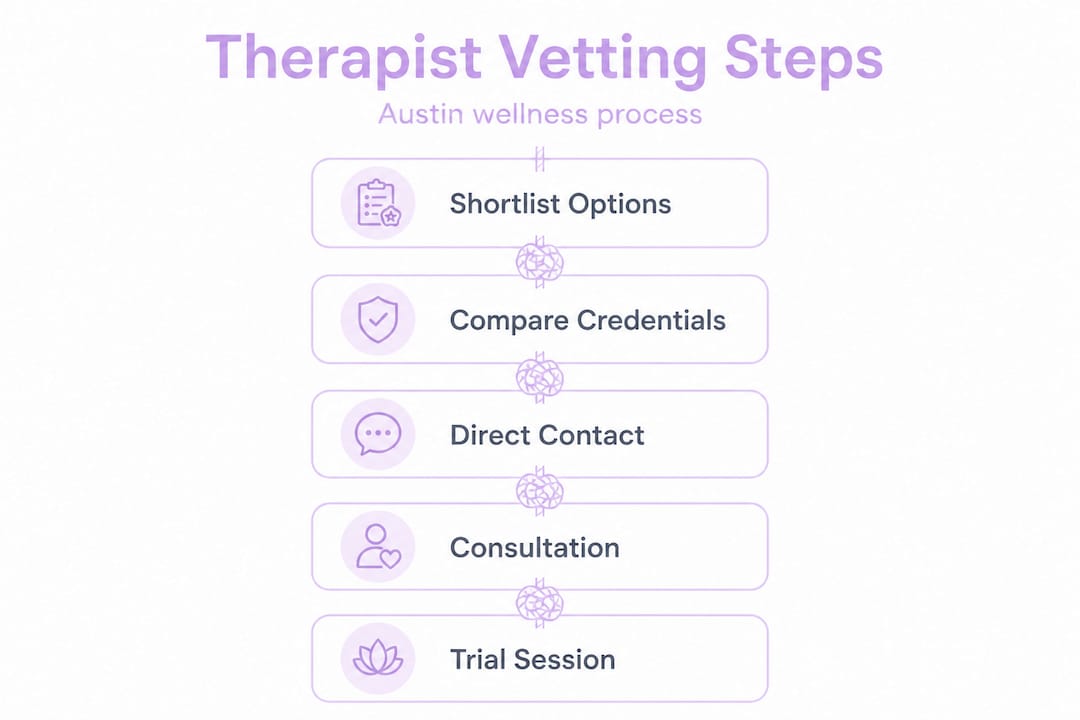
Step 1: Build your shortlist using multiple sources.
Start with more than one platform. Google reviews give you a general sense of a therapist's reputation, but MassageBook, Yelp, and LinkedIn profiles often reveal more detailed information about credentials and specialties. Use LinkedIn for profiles and MassageBook or Yelp for reviews, then cross-verify all license numbers on the TDLR site. Aim for a shortlist of three to five practitioners before narrowing down.
Step 2: Compare by credentials, specialties, and reviews.
Once you have your list, put them side by side. Prioritize therapists with experience in chronic pain and injuries, and pay attention to how they describe their work. Vague language like "relaxing massage" or "therapeutic touch" without specific modality training is less reassuring than clear descriptions of techniques and conditions addressed. Look for therapists who specifically mention your issue, whether that's sciatica, post-surgical recovery, stress-related tension, or something else.

| Factor | What to look for | Red flag |
|---|---|---|
| Credentials | TDLR license + specialty certifications | No license number listed |
| Specialties | Matches your specific condition | Only general massage listed |
| Reviews | Consistent, detailed, recent | Few reviews or generic praise |
| Communication | Responsive, asks about your needs | No intake form or contact info |
| Session length | Realistic for your condition | Only 30-min options for chronic pain |
Step 3: Contact your top picks directly.
This step matters more than people think. Send a short message or make a call. Describe your specific pain or stress situation and ask how they typically approach it. A skilled therapist will ask follow-up questions, not just confirm availability. If you're exploring massage for injury recovery, you want someone who understands tissue healing stages and adjusts pressure accordingly.
Step 4: Verify licenses on TDLR before booking.
This is non-negotiable. Every therapist on your final list should clear this check. The TDLR database is free, searchable by name, and takes less than two minutes. No license, no booking.
"An informed consumer is a safer consumer. Knowing your practitioner's credentials and approach helps you make choices that support your health goals."
Step 5: Schedule a trial session before committing.
A single session tells you a lot. Notice how the therapist communicates at the start, whether they ask about your health history, and how they adjust based on your feedback mid-session. Strong therapists who offer deep tissue massage will check in regularly about pressure and comfort. Passive therapists who work on autopilot are a mismatch for people with chronic or complex pain.
Pro Tip: If you have a chronic condition like fibromyalgia or a herniated disc, let the therapist know before the session ends so they can share how they'd approach ongoing care. Their answer will tell you whether they're thinking long-term or just working through a routine. A therapist who supports holistic wellness will frame your care as a partnership, not a transaction.
Consultation: Setting expectations and screening for your needs
After you've found a possible match, your initial consultation is where you confirm fit and rule out mismatches.
A strong first consultation isn't just a meet-and-greet. It's a professional assessment. The therapist should ask about your health history, any current injuries, medications, or conditions that might affect treatment. They should ask what you're hoping to get out of the sessions, not just what hurts, but how the pain affects your daily life, sleep, and movement. This distinction matters.
What a thorough consultation includes:
- A review of your health history and any diagnosed conditions
- Questions about pain patterns, triggers, and how long the issue has been present
- An explanation of the techniques they plan to use and why
- A discussion of session frequency and realistic outcomes
- Clear information about what to expect during and after the first session
Assessing communication, the consultation process, and how check-ins are handled during a session is a reliable indicator of professional quality. Therapists who skip the intake process are cutting corners, and those corners protect you.
For clients with more complex needs, the consultation also needs to address contraindications. These are health conditions or circumstances that may make certain techniques unsafe. Examples include acute inflammation, recent surgeries, blood clotting disorders, or certain cardiovascular conditions. Screening for contraindications through trial sessions is especially important if you have layered health concerns. Don't assume the therapist will automatically know what to avoid. Be thorough and honest about your full health picture.
Pro Tip: Write down your top three pain points and your three biggest goals before the consultation. Reading from a list feels less awkward than you'd expect, and it ensures you don't forget something important in the moment.
Therapists who specialize in pain relief and recovery will often propose a treatment plan with a clear arc, starting with assessment sessions, then moving into more targeted work as they understand your body better. This is a good sign. A plan that adjusts over time reflects the reality that pain and recovery are not linear.
Understanding what a skilled massage therapist actually does in a session also helps you come in with realistic expectations. They are not doctors, but they are trained to support your nervous system, release soft tissue restrictions, and help your body move toward its own natural balance.
Holistic and intuitive approaches: Beyond the basics
Many people stop at finding a general therapist, but holistic techniques can make a surprising difference for complex issues.
Holistic massage goes further than muscle mechanics. It recognizes that pain, stress, and tension are not purely physical. An intuitive therapist pays attention to how your body responds in real time, noticing where you hold tension, how your breathing changes, and where the nervous system seems to resist letting go. This kind of attentiveness can't be replicated by someone following a scripted routine.
In Austin, you can find therapists offering a range of holistic and intuitive approaches such as Thai mat massage, craniosacral therapy, and myofascial release, each with distinct benefits. These methods are verified through TDLR-compliant training, but they operate with a more integrative philosophy than standard Swedish or relaxation work.
Key holistic modalities and what they offer:
- Myofascial release targets the connective tissue layer surrounding muscles, addressing widespread pain that deep tissue alone can't reach
- Craniosacral therapy uses extremely light touch to support the central nervous system, helpful for migraines, anxiety, and trauma-related tension
- Thai mat massage combines guided stretching with rhythmic pressure, improving flexibility and circulation without a table
- Energy-informed touch focuses on the practitioner's presence and intentionality, helping your nervous system feel safe enough to release deeply held tension
Research supports the value of these approaches. Massage is effective as a complementary treatment for chronic pain with regular sessions, and it carries low risk when the therapist properly screens for contraindications. The operative word is "regular." One session can offer relief, but consistent, intentional care is what produces lasting results.
| Approach | Typical session focus | Best condition match |
|---|---|---|
| Myofascial release | Fascial layers, whole-body tension | Fibromyalgia, chronic fatigue |
| Craniosacral | Nervous system, skull-sacrum rhythm | Migraines, stress, anxiety |
| Thai mat | Stretching, energy lines | Stiffness, sedentary pain |
| Intuitive touch | Responsive, body-led work | Emotional tension, complex pain |
If you're looking to understand the full range of massage therapy benefits or want to explore holistic massage alternatives in Austin, taking the time to research these modalities before your first session will help you ask smarter questions and get better results.
Pro Tip: Ask any potential holistic therapist to explain how they would specifically address your condition using their chosen modality. A confident, clear answer shows competence. A vague or generic response is a signal to keep looking.
Our perspective: What most people get wrong about choosing a massage therapist
You now understand the how-to, but there are a few hard-earned truths our team wants Austin clients to hear.
The biggest mistake we see people make is chasing credentials or aesthetic appeal while ignoring how a therapist actually communicates. A wall of certifications is reassuring, but it's not the whole picture. We've heard from clients who saw highly credentialed therapists who never once asked how they were feeling mid-session, never adjusted pressure, and never revisited the treatment plan. Credentials without attentiveness produce frustrating results.
Social media presence is another misleading signal. An Instagram-friendly studio with beautiful photos doesn't guarantee your therapist listens well or understands your specific kind of pain. The best practitioners often invest their time in continuing education and client care rather than content creation.
Here's what we believe matters most: how you feel before, during, and after the consultation. Not just physically, but emotionally. Did the therapist make you feel heard? Did they explain their reasoning? Did you feel rushed? These experiences predict your long-term satisfaction far more reliably than any credential.
Investing in a trial session, even if it feels like an extra expense, protects you. It's the most honest test of fit. And staying open to a conversation about adjusting the approach over time is just as important. Pain changes, and your massage therapy workflow should change with it.
Trust your body's response. A therapist who is right for you will feel safe, intentional, and worth returning to.
Ready to find relief? Book a session with Austin's trusted massage therapists
If you're ready to put all these tips into action, here's the quickest way to start your Austin massage therapy journey.
At EveryKnot Massage, Caitlin brings licensed, multi-modality training together with a genuinely intuitive approach to chronic pain, stress, injury recovery, and more. Every session is built around your specific needs, not a preset routine.

Whether you're navigating sciatica, recovering from an injury, carrying years of stress in your shoulders, or simply want intentional, supportive care, EveryKnot Massage in Austin is designed for you. You can explore service details, read about Caitlin's approach, and book your personalized session directly online. Taking that first step, even just scheduling a consultation, puts you on a path toward real, lasting relief.
Frequently asked questions
How do I verify a massage therapist's license in Texas?
You can verify any Texas therapist's license using the TDLR's free online verification tool, which is searchable by name or license number.
Which massage techniques help most with chronic pain?
Chronic pain responds well to regular sessions using myofascial release, deep tissue, or craniosacral methods, especially when sessions are consistent and customized to your specific condition.
What questions should I ask during a massage consultation?
Ask about licensing, experience with your specific health issue, which techniques they plan to use, and how they handle medical history and check-ins during a session.
Are holistic massage techniques safe?
Holistic massage techniques are generally low-risk when your therapist properly screens for contraindications such as acute injuries or certain medical conditions before beginning treatment.