

You've probably seen the phrase "intuitive massage" and wondered what it actually means. It sounds appealing, but it's also a little vague. Does the therapist just do whatever they feel like? Is it a specific technique? Is it even backed by research? If you're living with chronic pain or stress in Austin and looking for real, lasting relief, you deserve a clear answer before you book your next session.
Table of Contents
- What intuitive massage really means
- How intuitive massage addresses pain and stress
- Trauma-informed and emotional support elements
- What to expect: A personalized intuitive massage session
- Why intuitive massage only works with real communication
- Discover intuitive massage in Austin with EveryKnot
- Frequently asked questions
Key Takeaways
| Point | Details |
|---|---|
| Not a fixed routine | Intuitive massage means every session adapts to your unique needs, not a generic protocol. |
| Evidence for relief | Massage, including intuitive styles, has demonstrated benefits for pain and stress when tailored properly. |
| Trauma-informed focus | Leading therapists integrate trauma-aware principles for emotional safety and comfort. |
| Communication is essential | Effective intuitive work depends on honest, regular feedback between client and therapist. |
| Personalized Austin care | Austin offers intuitive, trauma-informed options for anyone seeking real relief from pain or tension. |
What intuitive massage really means
Intuitive massage is one of those terms that can cause genuine confusion, and understandably so. Unlike Swedish or deep tissue massage, which follow recognizable structural protocols, intuitive massage is not a fixed routine. It's a philosophy of care. It means your therapist continuously reads your body's responses and adjusts the session in real time based on what you actually need.
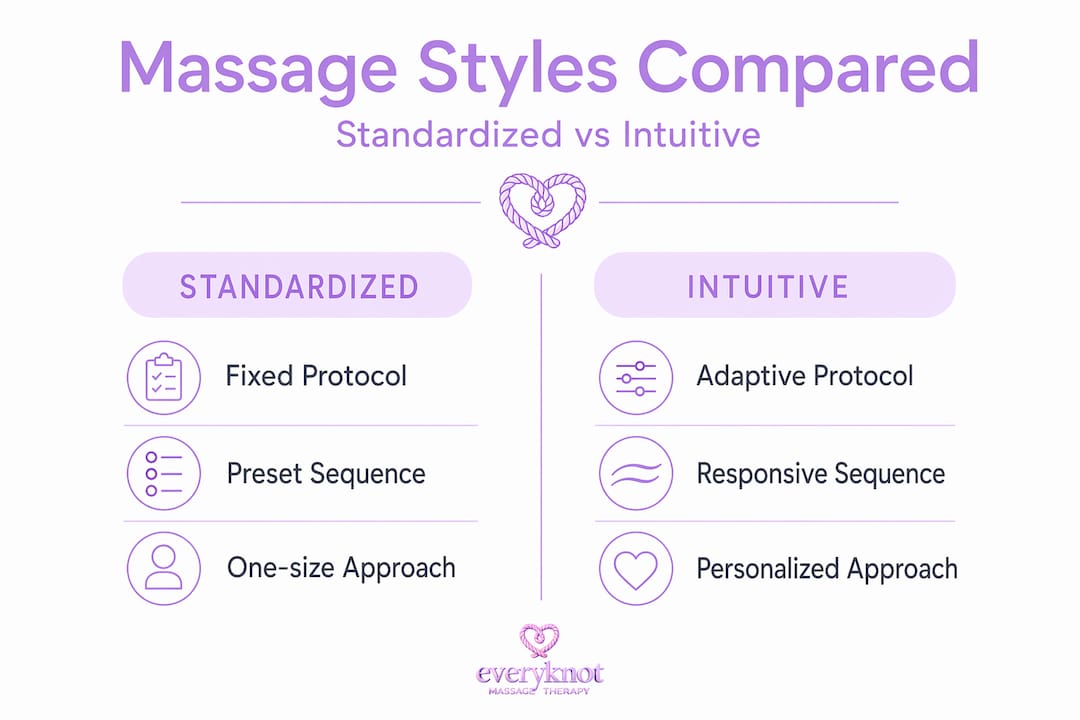
Think of it this way: a standardized massage follows a script, while an intuitive massage is more like a conversation. Your therapist might start with slower, lighter strokes to assess tissue quality and tension patterns, then shift to deeper work in specific areas, incorporate breathwork cues, or even pause to check in with you about pressure. The session is shaped by your body, your history, and your feedback, not by a pre-set timer or sequence.
It's worth being direct about the terminology, though. As research confirms, "intuitive massage" is not a universally standardized medical procedure. What therapists call intuitive touch may blend hands-on massage with other elements such as breathwork, energy work, or trauma-informed considerations depending on the provider. This means the quality and style of an intuitive session can vary significantly, which is why understanding what to look for in a provider really matters.
Here's a quick comparison to help clarify:
| Feature | Standardized massage | Intuitive massage |
|---|---|---|
| Protocol | Fixed sequence and timing | Adapts in real time |
| Client feedback | Noted at intake | Ongoing throughout |
| Technique variety | One modality per session | Blends multiple approaches |
| Emotional elements | Typically not addressed | Can include trauma-awareness |
| Goal | Consistent delivery | Individualized outcome |
The roles a skilled massage therapist plays in an intuitive session go beyond technique. They serve as a listener, an observer, and a responsive guide. The result is a session that feels less clinical and more attuned to what your body is actually communicating. For clients with complex or hard-to-treat conditions, that responsiveness is often the difference between feeling dismissed and feeling genuinely supported. Personalized massage therapy like this starts with that commitment to listening first.
How intuitive massage addresses pain and stress
With that understanding of "intuitive" in mind, let's look at how this flexible approach may support pain and stress relief, according to current research.

Massage therapy overall has a meaningful evidence base for several conditions. A broad review of massage outcomes supports potential benefits for pain and stress-related outcomes, though protocols vary and results depend on the specific condition and study quality. The key takeaway: massage works for many people, but a one-size-fits-all approach has clear limits.
Here's a summary of commonly studied outcomes:
| Condition | Commonly studied outcome | Evidence direction |
|---|---|---|
| Chronic low back pain | Pain intensity, function | Moderately positive |
| Neck and shoulder tension | Pain, range of motion | Positive |
| Anxiety and stress | Cortisol levels, mood | Positive |
| Cancer-related fatigue | Fatigue, quality of life | Positive |
| Sleep disturbance | Sleep quality | Moderate support |
| Headache/migraine | Frequency, intensity | Emerging support |
This is where the "intuitive" element earns its value. When massage therapy for chronic pain is delivered responsively rather than formulaically, it can account for day-to-day fluctuations in your pain levels. If you're having a flare-up, the session adapts. If one area needs more time, the therapist doesn't move on just because the script says so.
Conditions that may benefit most from an intuitive, responsive approach include:
- Chronic low back or neck pain that shifts locations or intensity
- Fibromyalgia or widespread muscle tenderness
- Stress-related tension headaches
- Sciatica with variable pain patterns
- Anxiety-linked muscle holding and guarding
- Post-injury recovery with sensitive tissue areas
The benefits of massage for stress relief are well-established enough that even brief sessions can shift your nervous system from a state of high alert into a calmer, more regulated baseline. When that responsiveness is built into the session design, you're not just relaxing for an hour. You're giving your nervous system a real chance to reset.
Pro Tip: Before your first intuitive massage session, ask your therapist exactly how they handle pressure adjustments and what they do if your pain increases during treatment. A confident, clear answer is a good sign.
Understanding the path to lasting relief with massage starts with recognizing that responsiveness, not just technique, is what drives outcomes for complex pain.
Trauma-informed and emotional support elements
While pain relief is central, intuitive massage offers something more for clients who carry stress in deeper ways. For many people in Austin, chronic tension is not just muscular. It's emotional. Stress from work, caregiving, grief, or past trauma can live in the body as muscle guarding, shallow breathing, and persistent holding patterns that don't respond well to purely mechanical pressure.
This is where trauma-informed principles become essential. Research supports that because intuitive massage may include nonstandard elements, clients with trauma histories or high stress and tension may benefit from a trauma-informed delivery framework built around safety, transparency, collaboration, empowerment and choice, and cultural and historical awareness.
What does trauma-informed massage actually look like in practice? It means your therapist does not just focus on your muscles. They pay attention to your nervous system's signals throughout the session. It means you are never surprised by a technique, never pressured to push through discomfort, and always in charge of what happens to your body.
Signs your therapist is using trauma-informed principles:
- They ask for your consent before each new area or technique
- They offer you choices: prone or supine, lighter or deeper, quiet or conversation
- They check in regularly without waiting for you to speak up
- They explain what they're doing before they do it
- They respond to subtle physical cues, not just verbal ones
- They make it easy for you to pause, stop, or redirect the session at any time
- They follow up after sessions to note patterns or concerns
Exploring trauma-informed massage frameworks through a provider who takes these principles seriously can transform what might feel like a routine appointment into a genuinely restorative experience.
For clients who have had past negative body experiences or who feel anxious about touch, this approach creates the conditions your nervous system needs to feel safe enough to release held tension. The emotional and physical are not separate. They work together, and a good intuitive therapist understands that.
Pro Tip: Before booking, ask your therapist how they handle it if a client becomes emotionally overwhelmed during a session. A thoughtful, prepared answer tells you a lot about their training and care level.
What to expect: A personalized intuitive massage session
With safety, communication, and responsive touch in mind, here's how a personalized intuitive session typically unfolds for clients in Austin.
-
Consultation and intake. Your session begins before any touch happens. You'll discuss your current pain, stress levels, medical history, and any areas you want to focus on or avoid. This is your opportunity to share everything that feels relevant, including emotional stressors if you choose to.
-
Goal setting. Together, you and your therapist identify the primary goals for the session. Are you hoping for pain reduction in a specific area? General stress relief? Help with sleep? Knowing the intention shapes how the therapist listens and responds throughout.
-
Session experience. Once you're on the table, the therapist will begin slowly and observantly. They're not following a rigid plan. Instead, they're reading your tissue quality, your breathing patterns, and your physical responses to each stroke. They may shift between lighter and deeper work, address trigger points, incorporate breathwork cues, or pause entirely to check in with you.
-
Ongoing feedback. You should feel comfortable speaking up at any point. "Can you go lighter?" or "That area feels really tight, can you spend more time there?" are not interruptions. They are exactly the information your therapist needs. Evaluating an intuitive session well means asking how your therapist combines responsiveness with safety: informed consent, clear pressure communication, and adjustment plans when pain flares.
-
Follow-up and aftercare. After the session, your therapist should offer observations about what they noticed and practical suggestions for between-session care. This might include stretches, hydration notes, or guidance on when to schedule your next appointment.
For restorative massage for recovery, this entire arc matters. It's not just what happens during the session. It's how you're prepared beforehand and supported afterward.
Common things clients worry about: "What if I don't know what to ask for?" You don't need to. Your therapist's job is to help guide that conversation. You can also request that they check in every 10 to 15 minutes so you always have an easy opening to give feedback.
Understanding why massage relieves tension gives you more confidence walking in. When you know what the process is designed to do, you can participate more actively in making it work for you.
Pro Tip: If you're nervous about your first intuitive session, write down your top three concerns and one or two body areas that are off limits. Hand it to your therapist at the start. It removes the pressure of remembering everything in the moment.
Why intuitive massage only works with real communication
Here's something most guides won't say plainly: the word "intuitive" can create unrealistic expectations. Some clients arrive hoping their therapist will simply know what they need without much input. That's not how it works, and expecting it to be that way can actually reduce the effectiveness of your session.
The real magic in intuitive massage is not psychic. It's collaborative. A skilled therapist reads your body well. They notice when you hold your breath, when a muscle guards, when pressure is too much. But they are not reading your mind. They need your words too.
The best sessions we've witnessed are the ones where the client feels safe enough to say "that's too deep" or "I'm having a hard week emotionally and I just need something gentler." Those honest moments are what allow the session to truly adapt. Without them, even the most talented therapist is working with incomplete information.
There's also a real risk on the other side. A therapist who leans too heavily on "intuition" without checking in can miss pain escalation, apply pressure incorrectly for a client's condition, or skip crucial informed consent steps. The label does not replace training, licensure, or professional responsibility.
What makes intuitive massage genuinely valuable is the intersection of clinical skill and genuine responsiveness. One without the other is not enough. When you find a therapist who holds both, the results can be remarkable. Supporting your overall wellness through massage depends on that partnership being real, not assumed.
Discover intuitive massage in Austin with EveryKnot
If you've been managing chronic pain, persistent stress, or tension that just won't let go, a personalized, trauma-informed approach might be exactly what your body has been waiting for.
At EveryKnot Massage, Caitlin combines certified training in multiple modalities with a genuinely responsive, client-centered approach that puts your comfort and safety first. Sessions are adapted in real time, informed consent is built into every appointment, and no two sessions look exactly the same because no two clients are exactly the same. Whether you're managing chronic low back pain, recovering from an injury, navigating sciatica, or simply carrying too much stress, EveryKnot is ready to work with you where you are. Book your personalized session in Austin today and experience what intentional, intuitive care actually feels like.
Frequently asked questions
Is intuitive massage safe for people with chronic pain?
When delivered by a trained, communicative therapist, intuitive massage can be safely adapted for most pain conditions. Evidence supports potential benefits for pain and stress-related outcomes, though results depend on condition and study quality. Always discuss your full health history and comfort level before starting.
How is intuitive massage different from deep tissue or Swedish massage?
Unlike fixed protocols with set sequences, intuitive massage blends techniques and adapts each session based on your real-time feedback, needs, and comfort rather than following a standardized script. It may incorporate breathwork, energy work, or trauma-informed elements depending on what you need that day.
Should I tell my therapist if I'm nervous or have a trauma history?
Yes, absolutely. Sharing your concerns allows your therapist to apply trauma-informed practices built around safety, transparency, collaboration, and choice, tailoring the entire session to your emotional as well as physical needs.
What questions should I ask before booking an intuitive massage?
Ask how the therapist personalizes sessions, how they handle pain flare-ups mid-session, and how they ensure your ongoing comfort and consent. A strong evaluative approach combines responsiveness with clear pressure communication and adjustment plans when pain increases.